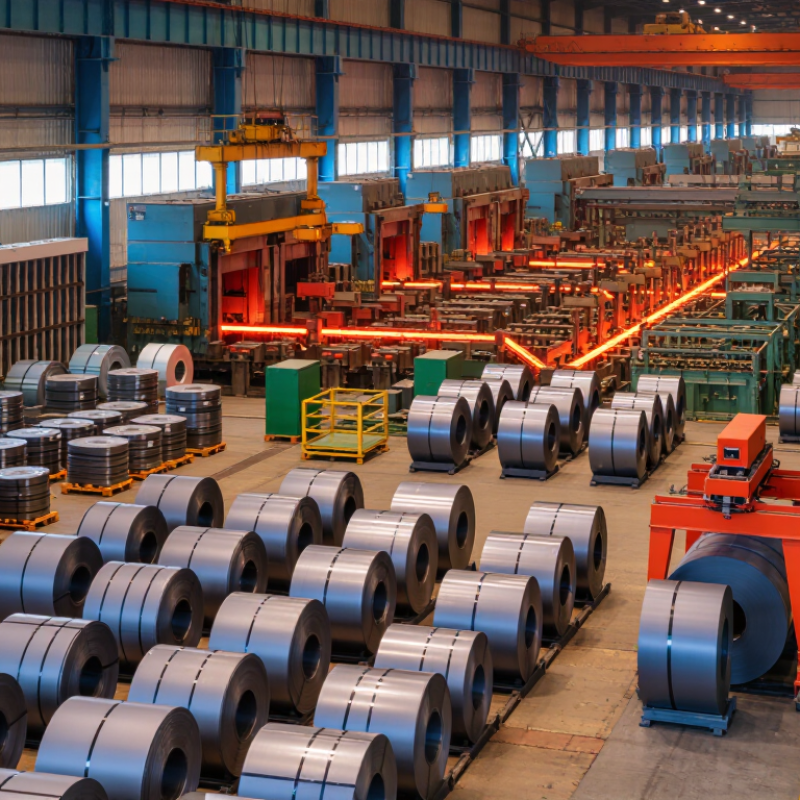
Choosing among the top hot rolled sheet manufacturers requires more than comparing prices. Global buyers must examine mill capability, product consistency, delivery performance, and technical support. Thickness range matters. So does surface condition.
A reliable manufacturer should provide clear chemical data, mechanical test results, dimensional tolerances, and traceable inspection documents. Buyers should also confirm grades, coil widths, edge conditions, and available cutting services before placing an order. A strong supplier can explain how its hot rolled sheet performs in construction, machinery, transportation, and fabricated components. Factory audits, recognized certifications, and transparent complaint handling add valuable confidence. Still, no manufacturer fits every project.
John J. Ferriola, former Nucor chairman and chief executive, said, “Steel is the most recycled material in the world.” That reminder adds an important sustainability question to supplier research. Can the mill document recycled content, energy use, emissions control, and responsible sourcing? Perhaps not every published claim is equally useful. Buyers should test the evidence.
This guide reviews major hot rolled sheet manufacturers serving international markets. It considers production scale, quality systems, export experience, product range, lead times, and customer support. Freight routes and regional inventory can change the real purchasing cost. Small details matter.
The strongest choice may not be the largest producer. It may be the supplier that communicates quickly, delivers consistently, and admits limitations before problems reach the factory floor.
For global buyers, hot-rolled sheet selection often begins with three familiar grades: ASTM A36, EN S275, and JIS SS400. They share broad structural applications, but they are not identical materials. Each standard defines different requirements for chemical composition, mechanical performance, dimensions, and testing.
ASTM A36 is widely used for general structural fabrication. Its minimum yield strength is commonly specified near 250 MPa, depending on product form and thickness. EN S275 generally offers a minimum yield strength of 275 MPa for thinner sections, with values changing as thickness increases. JIS SS400 is also a general structural grade, but its designation does not directly match the strength value. The number refers mainly to tensile strength classification.
Check the details carefully.
A reliable purchasing process should include the exact standard edition, grade suffix, thickness range, heat number, and mill test certificate. For example, a 10 mm sheet may meet one strength requirement, while a thicker plate from the same grade may not. Surface scale, edge condition, flatness, and cutting tolerance also affect fabrication results. A common mistake is treating equivalent grade tables as automatic substitutions. They are useful references, not approval documents. No standard removes every uncertainty. Independent testing may still be wise for welded frames, lifting structures, or heavily loaded components.
Global buyers often begin with thickness and width requirements. Hot rolled sheets commonly range from 1.2 to 25 mm thick. Widths may extend from 600 to 2,000 mm. This range supports brackets, frames, machinery parts, storage systems, and structural assemblies.
Thickness is not merely a catalog figure. At 25 mm, handling and cutting equipment require more capacity. At 1.2 mm, flatness and surface condition need closer inspection. Width also affects nesting efficiency and material waste. A workable specification should match the final cutting plan.
Experienced purchasing teams request mill certificates, chemical composition, mechanical test results, and dimensional tolerances. Reliable manufacturers should explain applicable standards clearly. Surface condition matters too. Scale, edge cracks, and uneven trimming can create extra preparation work. Small defects become expensive.
Manufacturing capability should be checked against the requested size, grade, and delivery schedule. Before approval, buyers can review sample reports and inspect packed sheets. Cut one sample. Compare its measured thickness at several points, not only at the center. Packaging deserves attention because moisture can damage exposed surfaces during long transport. Steel should arrive with clear identification and traceable batch details. Still, no supplier performs perfectly on every order. An honest review should record both consistent results and recurring problems.
Capacity should mean dependable hot rolled sheet output, not only installed equipment. The World Steel Association reported global crude steel production of about 1.88 billion tonnes in 2024. Buyers should compare usable rolling capacity, slab supply, maintenance records, and monthly shipment history. A mill with smaller capacity may still perform better during tight delivery windows. This is often overlooked.
ISO 9001 certification is another ranking filter. The ISO Survey 2023 recorded roughly 1.27 million ISO 9001 certificates worldwide. However, certification confirms a quality management system, not flawless sheets. Buyers should request coil inspection reports, thickness tolerances, surface standards, and corrective-action records. Audit the details.
Lead time must cover order confirmation, production, inspection, and port release. UNCTAD’s Review of Maritime Transport 2024 highlights continuing disruption risks across global shipping routes. Therefore, published production time can be misleading. Compare promised dates with the manufacturer’s last twelve months of shipment records. Export reach should be measured through verified destination markets, customs data, and document accuracy. OECD steel market reports also warn of expanding global capacity pressure, which can create aggressive offers but uneven service. Ranking remains imperfect when public data is incomplete.
Global buyers often compare four major producer profiles when sourcing hot rolled sheet.
A leading European integrated mill typically offers broad grades, large production capacity, and strong supply coverage across regions.
A major Korean producer is known for process consistency, export experience, and dependable delivery planning.
A Japanese manufacturer often emphasizes tight dimensional control, surface quality, and demanding automotive specifications.
A large Chinese steel group can provide extensive volume, competitive pricing, and varied product sizes.
Each profile has strengths, but suitability depends on the project.
Hot rolled sheet should be evaluated beyond the quoted price.
Check thickness tolerance, coil weight, yield strength, chemical composition, and edge condition.
Ask for recent mill test certificates and independent inspection options.
Port distance also matters. A cheaper coil can lose its advantage after freight, storage, and inland handling.
One detail is easy to miss. Confirm whether the quoted dimensions reflect actual usable material after trimming and processing.
I would not treat any producer ranking as permanent; capacity, energy costs, and service performance can change.
Tips:
Compare at least three technical offers using the same specification.
Request samples when surface appearance matters.
Clarify packing, labeling, certificate language, and claim procedures before payment.
Keep written records of every tolerance and delivery promise.
Small gaps become expensive later.
Top Hot Rolled Sheet Manufacturers for Global Buyers
Reliable sourcing starts with documents, not attractive quotations. Experienced buyers request a Mill Test Certificate before approving hot rolled sheets. The certificate should match the purchase order, heat number, grade, thickness, and mechanical results. Ask for an EN 10204 3.1 certificate issued by the mill’s authorized inspection department. A generic laboratory report may not provide the same traceability. Check every heat number. Small mismatches matter.
Incoterms must also appear clearly in the commercial offer. FOB, CFR, CIF, and DAP create different responsibilities for freight, insurance, customs clearance, and delivery risk. Confirm the named port or place, shipment schedule, and transfer point for risk. HS codes require equal care. A supplier’s suggested code can be useful, but the importer should verify it with local customs guidance. Classification may vary by product details and national practice.
Tips: Compare the MTC with the markings on each bundle, including grade, dimensions, and heat number. Request scanned certificates before payment, then retain original shipping documents. In my experience, buyers sometimes focus on price and overlook document consistency. That is a costly weakness. Verification is not perfect, especially when translations or revised packing lists create confusion. Keep one approved specification sheet, record every change, and ask the mill to explain unclear values in writing. This simple habit improves confidence when selecting manufacturers for global orders.
| Verification Dimension | Buyer Verification Data | Applicable Standard or Trade Reference | Documents or Checks to Request |
|---|---|---|---|
| Product Identification | Confirm the product is hot-rolled carbon or low-alloy steel sheet or plate, with the agreed thickness, width, length, surface condition, edge condition, and dimensional tolerances. | Purchase specification; applicable product standard; agreed tolerance standard. | Signed technical specification, packing list, dimensional inspection report, product photographs, and heat or batch identification. |
| Common Material Grades | Typical internationally traded grades include ASTM A36, ASTM A572 Grade 50, EN 10025-2 S235JR, EN 10025-2 S355JR, and JIS G3101 SS400. The selected grade must match the required chemical and mechanical properties. | ASTM A36; ASTM A572/A572M; EN 10025-2; JIS G3101. | Purchase order showing the exact grade, MTC showing the same grade, and test results compared with the limits in the applicable standard. |
| Mill Test Certificate | Verify heat number, product description, nominal dimensions, quantity, chemical composition, tensile strength, yield strength, elongation, and impact results when specified. | The certificate should correspond directly to the supplied heat, coil, sheet, or plate. | Original or electronically verifiable certificate, heat-number traceability, and consistency between the MTC, marking, packing list, and invoice. |
| EN 10204 Type 3.1 | An EN 10204 3.1 inspection certificate contains specific inspection and test results for the supplied products and is validated by the manufacturer's authorized inspection representative who is independent of the manufacturing department. | EN 10204:2004, Type 3.1 inspection certificate. | Certificate designation “EN 10204 3.1,” authorized signature or electronic approval, product traceability, test values, applicable specification, and certificate date. |
| EN 10204 Type 3.2 | Use Type 3.2 when the contract requires purchaser or officially designated third-party witness or validation in addition to the manufacturer's inspection function. | EN 10204:2004, Type 3.2 inspection certificate. | Inspection and test plan, witness-point records, third-party or purchaser endorsement, and final 3.2 certificate. |
| Chemical Composition | Check carbon, manganese, silicon, phosphorus, sulfur, and any specified alloying elements against the limits for the ordered grade. Heat analysis and product analysis requirements may differ. | Applicable ASTM, EN, JIS, or other agreed material standard. | Heat chemical analysis in the MTC, laboratory method where required, and matching heat number on material markings. |
| Mechanical Properties | Verify yield strength, tensile strength, elongation, and impact toughness where specified. Testing direction, specimen location, and test temperature should follow the agreed standard. | Applicable material standard and agreed inspection and test plan. | Tensile test report, Charpy impact report when required, test temperature, specimen orientation, and laboratory or mill identification. |
| Surface and Internal Quality | Define acceptable scale, rust, pits, laminations, cracks, edge defects, and flatness before production. Pickled or descaled material should be specified separately from ordinary hot-rolled mill-finish material. | Contract quality clause, agreed surface class, and relevant product standard. | Pre-shipment photographs, visual inspection report, surface-quality agreement, and optional ultrasonic testing report for applications requiring internal soundness. |
| Dimensional Tolerances | Confirm thickness, width, length, flatness, squareness, and edge tolerances. Tolerances must be linked to the relevant product standard or expressly stated in the purchase order. | Relevant dimensional tolerance standard, such as EN 10051 for continuously hot-rolled steel sheet and plate where applicable. | Calibration records, inspection measurements, sample size, measuring equipment details, and final dimensional inspection report. |
| Traceability | Each bundle, sheet, or plate should remain traceable to the heat number and the corresponding MTC throughout loading and delivery. | Contract traceability requirement and applicable quality-management procedure. | Bundle tags, heat markings, coil or plate numbers, packing list, MTC cross-reference, and loading photographs. |
| Incoterms® 2020 | Record the named place or port and the exact Incoterms® 2020 rule. Common choices include FOB for sea shipments, CFR or CIF for sea freight, and FCA for containerized or multimodal shipments. | ICC Incoterms® 2020. The chosen rule determines cost, delivery point, risk transfer, and certain transport obligations. | Contract wording such as “FOB [named port], Incoterms® 2020,” freight quotation, export declaration responsibility, and insurance terms where applicable. |
| Incoterms Risk Control | Do not treat CIF or CFR as delivery to the buyer's warehouse. Under these rules, risk generally transfers at shipment on board the vessel, even though the seller arranges main carriage; CIF also includes minimum insurance cover. | Incoterms® 2020 rule-specific delivery, risk, cost, and insurance provisions. | Bill of lading, cargo insurance certificate for CIF shipments, commercial invoice, packing list, and agreed named port or place. |
| HS Classification | Hot-rolled flat products of iron or non-alloy steel, with a width of 600 mm or more, not clad, plated, or coated, are generally classified under HS heading 7208. The final national tariff subheading depends on thickness, width, carbon content, and country rules. | HS heading 7208: flat-rolled products of iron or non-alloy steel, of a width of 600 mm or more, hot-rolled, not clad, plated, or coated. | Customs broker classification review, product datasheet, commercial invoice, dimensions, grade, coating status, and importing-country tariff ruling where available. |
| HS Code Accuracy | Do not use HS 7208 automatically for coated, galvanized, cold-rolled, stainless, or narrower products. These may fall under different headings or subheadings. | Current national customs tariff based on the Harmonized System and applicable trade measures. | Written classification confirmation, import duty calculation, anti-dumping or safeguard screening, and comparison of invoice description with the customs entry. |
| Packing and Marking | Specify bundle weight, lifting points, moisture protection, edge protection, seaworthy packing, and marking requirements. Packaging should suit the transport route and destination climate. | Contract packing specification, carrier requirements, and destination-country import rules. | Packing list, bundle photographs before loading, gross and net weights, dimensions, shipping marks, and container or truck loading record. |
| Pre-Shipment Inspection | For higher-value or technically critical orders, inspect quantity, dimensions, markings, surface condition, packing, and documentation before dispatch. | Agreed inspection and test plan, purchase order, and independent inspection scope. | Independent inspection report, sampling plan, nonconformity record, corrective-action evidence, and release authorization. |
| Payment and Document Control | Link payment milestones to document submission and inspection acceptance. For documentary credit transactions, ensure the MTC, invoice, packing list, and transport documents use consistent descriptions. | Sales contract, letter-of-credit terms where applicable, and agreed document checklist. | Approved proforma invoice, documentary credit clauses, document checklist, final invoice, packing list, MTC, and transport document. |